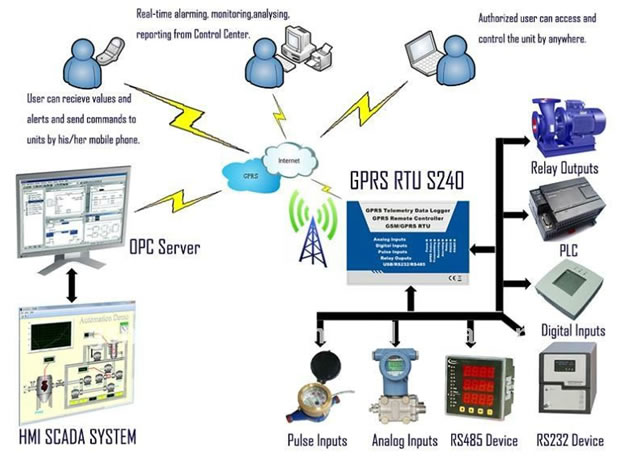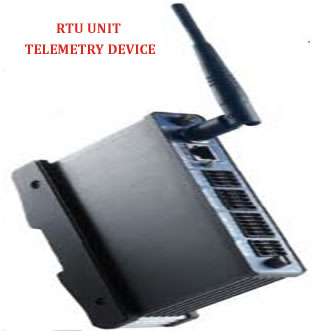
Fortune Group Wll Control Systems is a Automation software engineering firm specializing in the development of RTU (Remote Terminal Units) for water projects, OIL and GAS Projects. We can provide in depth solution to all your customized needs and provide best engineering solutions.
Today’s telemetry systems are built from commercial-off-the-shelf (COTS) products. But while they all have many common elements, they are each uniquely configured to meet specific application requirements. A telemetry system is often viewed as two components, the Airborne System and the Ground System. In actuality, either or both may be in the air or on the ground. Data acquisition begins when sensors (aka, transducers) measure the amount of a physical attribute and transform the measurement to an engineering unit value. Some sensors produce a voltage directly (thermocouples for temperature or piezoelectric strain gages for acceleration), while others require excitation (resistive strain gages, potentiometers for rotation, etc.). Sensors attached to signal conditioners provide power for the sensors to operate or modify signals for compatibility with the next stage of acquisition. Since maintaining a separate path for each source is cumbersome and costly, a multiplexer (historically known as a commutator) is employed. It serially measures each of the analog voltages and outputs a single stream of pulses, each with a voltage relative to the respective measured channel. The rigorous merging of data into a single stream is called Time Division Multiplexing or TDM.
Remote reading of meters
• For impulse meters (water, electricity, etc.),
• Consumption monitoring with reports (hourly, daily,Monthly, minimum, maximum, load curve).
• Remote maintenance
• Wind-power farms
• Permanent monitoring of the facility based on information from
The medium voltage network protection systems (Sepam type),
• Remote restarting actions following incidents,
• Remote reading of the various metering systems.
• Installed base of PLCs
• Access to the PLCs in transparent mode(diagnosis, modification of programs, etc.),
• Automatic alarms via e-mail and/or SMS in case of faults(loss of communication with PLCs, occurrence of alarming events, etc.),
• Time stamped logs (events, consumption).
• Remote managementof public lighting
• Associated with the Lubio product range(energy savings of up to 40%),
• Provision of the information required for efficient
• management of the public lighting network(configurable alarm management, consumption
• follow-up, follow-up of energy savings),
• Modification, remote parameterizing(astronomical clock, event management),
• Maintenance aid (real-time knowledgeof the network’s condition).
• Facility monitoring
• Basic operation without local automatic controls (positions, measurements,
• metering, controls, archiving) with information transfer to a SCADAor by e-mail or SMS:
• Heating/ventilation installations,
• Refrigeration plants,
Water management
Telemetry is important in water management, including water quality and stream gauging functions. Major applications include AMR (automatic meter reading), groundwater monitoring, leak detection in distribution pipelines and equipment surveillance. Having data available in almost real time allows quick reactions to events in the field.
Energy monitoring
In factories, buildings and houses, energy consumption of systems such as HVAC are monitored at multiple locations; related parameters (e.g., temperature) are sent via wireless telemetry to a central location. The information is collected and processed, enabling the most efficient use of energy. Such systems also facilitate predictive maintenance.
Resource distribution
Many resources need to be distributed over wide areas. Telemetry is useful in these cases, since it allows the system to channel resources where they are needed; examples of this are tank farms in gasoline refineries and chemical plants.
Petrol and LPG Tank Level Monitoring
Petroleum and LPG tank levels are remotely monitored on a SCADA system in the Control room located very far from the field. Monitoring Fuel levels and various parameters like Temperature, pressure, density and others. The data is remotely transferred either by GSM or GPRS type of communication