
Building automation is a programmed, automated, intelligent network that monitors and controls the mechanical and lighting systems in a building. The objective is to create an intelligent building and reduce energy and maintenance costs.
Infrastructure
Controller
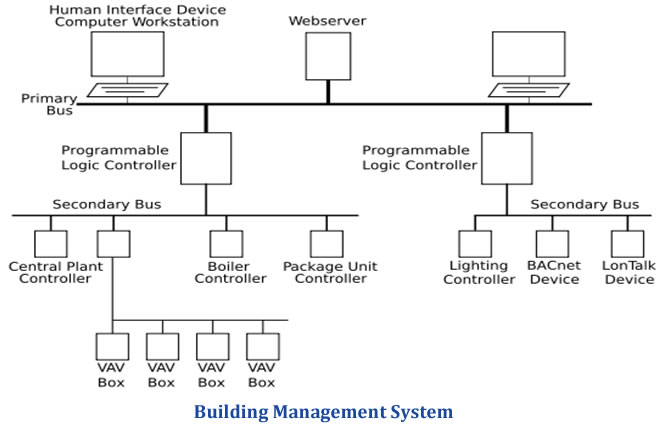
The controller is normally one or more application specific controllers, often with less complex programming. These controllers come in a wide range of sizes and capabilities to control devices that are common in buildings. Usually the primary and secondary buses are chosen based on what the controllers provide. Most PLCs provide general purpose feedback loops, as well as digital circuits.
Occupancy sensors
Occupancy is usually based on time of day schedules. Override is possible through different means. Some buildings can sense occupancy in their internal spaces by an override switch or sensor.
Lighting
Lighting can be turned on and off with a building automation system based on time of day, or the occupancy sensors and timers. One typical example is to turn the lights in a space on for a half hour since the last motion was sensed. A photocell placed outside a building can sense darkness, and the time of day, and modulate lights in outer offices and the parking lot.
Chilled water system
Chilled water is often used to cool a building's air and equipment. The chilled water system will have chiller(s) and pumps. Analog temperature sensors measure the chilled water supply and return lines. The chiller(s) are sequenced on and off to chill the chilled water supply.
Hot water system
The hot water system supplies heat to the building's air-handling units or VAV boxes. The hot water system will have a boiler(s) and pumps. Analog temperature sensors are placed in the hot water supply and return lines. Some type of mixing valve is usually used to control the heating water loop temperature. The boiler(s) and pumps are sequenced on and off to maintain supply.
Alarms and security
Many building automation systems have alarm capabilities. If an alarm is detected, it can be programmed to notify someone. Notification can be through a computer, cellular phone, or audible alarm. Some sites are programmed so that critical alarms are automatically re-sent at varying intervals. For example, a repeating critical alarm (of an uninterruptible power supply in 'by pass') might resound at 10 minutes, 30 minutes, and every 2 to 4 hours thereafter until the alarms are resolved. Security systems can be interlocked to a building automation system. If occupancy sensors are present, they can also be used as burglar alarms. Fire and smoke alarm systems can be hard-wired to override building automation. For example: if the smoke alarm is activated, all the outside air dampers close to prevent air coming into the building, and an exhaust system can isolate the alarmed area and activate an exhaust fan to move smoke out of the area. Life safety applications are normally hard-wired to a mechanical device to override building automation control.
Room Automation
Room automation is the consolidation of one or more manual system in a room under centralized control. It has less do to with HVAC and more to do with presentation systems within a room.
The most common example of room automation is corporate boardroom, presentation suites, and lecture halls, where the operation of the large number of devices that define the room function (such as Videoconferencing equipment, Video projectors, lighting control systems, Public address systems etc.) would make manual operation of the room very complex. It is common for room automation systems to employ a touch screen as the primary way of controlling each operation.
Manufacturers
AMX, LLC
Crestron Electronics, Inc.
Dynalite Intelligent Light Pty Ltd
Computrols, Inc.
Johnson Controls, Inc.
Siemens AG
Topology
Most building automation networks consist of a primary and secondary bus which connect high-level controllers (generally specialized for building automation, but may be generic programmable logic controllers) with lower-level controllers, input/output devices and a user interface (also known as a human interface device).
The primary and secondary bus can be BAC net, optical fiber, Ethernet, ARCNET, RS-232, RS-485 or a wireless network.
Most controllers are proprietary. Each company has its own controllers for specific applications. Some are designed with limited controls: for example, a simple Packaged Roof Top Unit. Others are designed to be flexible. Most have proprietary software that will work with BAC net or the proprietary Lon Talk.
Inputs and outputs are either analog or digital.
Analog inputs are used to read a variable measurement. Examples are temperature, humidity and pressure sensor which could be thermostat, 4-20 mA, 0-10 Volt or Platinum RTD (resistance temperature detector), or wireless sensors.
A digital input indicates if a device is turned on or not. Some examples of a digital input would be a 24VDC relay or air flow switch.
Analog outputs control the speed or position of a device, such as a variable frequency drive, a I-P (current to pneumatics) transducer, or an actuator. An example is a hot water valve opening up 25% to maintain a set point.
Digital outputs are used to open and close relays and switches. An example would be to turn on the parking lot lights when a photocell indicates it is dark outside.
Protocols and Industry Standards
Bacnet
BAC net is a network communications protocol for building automation and control systems that has been adopted worldwide as ISO 16484-5:2003.
C-Bus
DALI
DSI
Dynet
Energy Star is program created by the United States government to promote energy efficient consumer products.